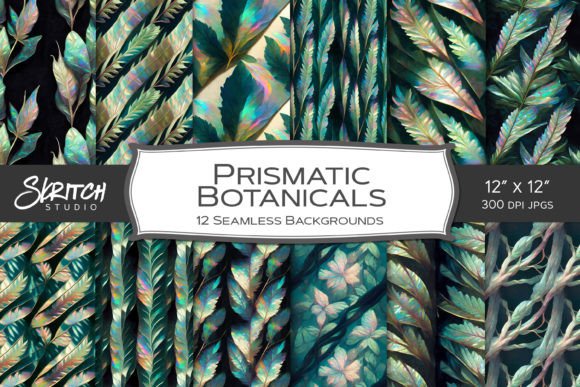
Prismatic Botanicals Seamless Patterns: A Practical Evaluation for Designers and Makers
Prismatic Botanicals Seamless Patterns is a curated collection of 12 high-resolution, painterly botanical motifs—primarily leaves and stems—designed with subtle holographic rainbow glints. Each pattern is delivered as a 3600 × 3600 pixel JPG file in a single ZIP archive, optimized for seamless tiling across large surfaces. Unlike generative AI patterns or vector-based botanical sets, these are hand-crafted digital paintings that retain organic texture and luminous depth. The result is a hybrid aesthetic: naturalistic enough for craft applications, yet refined and luminous enough for professional web or print use.
What Sets These Patterns Apart From Other Botanical Resources
Most botanical pattern libraries fall into one of three categories: vector-based illustrations (scalable but often flat), scanned watercolor textures (rich in grain but rarely tileable without visible seams), or AI-generated repeats (efficient but sometimes lacking intentional composition or tactile nuance). Prismatic Botanicals Seamless Patterns occupies a middle ground—digitally painted, carefully aligned for repeat, and intentionally textured to suggest light refraction. The holographic effect isn’t overpowering; it’s a delicate shimmer embedded in the pigment layer, visible under angled light or on glossy print stock, and subtly legible on screen.
This distinction matters most when evaluating suitability for specific outputs. For example, vector-based leaf patterns scale infinitely and work well for embroidery digitizing or laser-cut stencils—but they lack the soft edge variation and spectral highlights found in Prismatic Botanicals. Conversely, a high-res scanned gouache swatch may feel more “authentic” but often requires manual seam removal or tiling adjustments in Photoshop before use in web backgrounds or fabric printing. Prismatic Botanicals eliminates that step: each file is pre-tested for visual continuity at multiple zoom levels and tile densities.
Compatibility and Technical Fit Across Common Workflows
The 3600 × 3600 JPG format ensures broad compatibility without requiring specialized software. These files open natively in Procreate (as layered canvases if imported via drag-and-drop), Photoshop (with full blending mode support), Affinity Photo and Designer, GIMP, Canva (via upload), and even modern web design tools like Figma (when used as background fills). No proprietary plugin, subscription, or font dependency is involved.
That simplicity comes with tradeoffs. Because the files are raster-based and fixed-resolution, they’re not ideal for extremely large-format printing—say, 8 ft × 12 ft wall murals—without upscaling, which risks softening the fine holographic detail. For apparel printing on cotton or linen, however, 300 DPI at actual size translates cleanly to standard textile resolution requirements. Similarly, for digital use—blog headers, email newsletter backgrounds, or planner sticker sheets—the resolution provides ample headroom for retina displays and responsive scaling.
Real-World Use Cases Where These Patterns Shine
Prismatic Botanicals Seamless Patterns excels where visual warmth, subtle movement, and cohesive repetition matter more than strict geometric precision. Consider these practical examples:
- Handmade greeting cards: Printed on matte or soft-touch cardstock, the holographic glint reads as gentle iridescence—not flashy foil—adding quiet sophistication to birthday or thank-you designs.
- Digital scrapbooking and junk journals: Layered beneath handwritten journaling or vintage photo scans, the painterly stems provide rhythm without competing visually. Their organic flow supports intuitive page composition better than rigid geometric repeats.
- Web backgrounds for wellness or botanical brands: Tiled at 20–30% opacity behind light text, they create depth without sacrificing readability—unlike dense floral repeats that can visually fatigue readers over time.
- Washi tape or sticker sheet design: When sliced into narrow strips or die-cut shapes, the seamless nature ensures no awkward breaks at the edges—even across curved surfaces like planner tabs or laptop decals.
In contrast, users needing ultra-minimalist line art, monochrome ink sketches, or culturally specific botanical motifs (e.g., Japanese maple studies or South African protea arrangements) would likely look elsewhere. Prismatic Botanicals leans into a contemporary, luminous interpretation—not ethnobotanical accuracy or archival reproduction.
When Another Option Might Be a Better Fit
Prismatic Botanicals Seamless Patterns is purpose-built—not universal. It’s worth considering alternatives if your project demands:
- Scalability beyond 3600 px: For large-scale signage, architectural projections, or billboard mockups, vector-based botanical repeats or SVG pattern generators offer lossless enlargement.
- Color system control: While the JPGs include rich tonal variation, they aren’t provided with editable color swatches or Pantone references. Designers building brand-aligned palettes from scratch may prefer pattern kits with .ASE or .ACO files.
- Motion or interactivity: These are static assets. For animated website backgrounds or interactive digital installations, designers typically source looping video textures or build procedural patterns using code-based tools like p5.js or CSS gradients.
- Customization depth: If you regularly recolor, distort, or deconstruct base elements (e.g., isolating individual stems to re-compose new layouts), layered PSD or Procreate-native files—with masked components and non-destructive effects—offer greater flexibility than flattened JPGs.
Decision Factors to Guide Your Choice
Before selecting Prismatic Botanicals Seamless Patterns—or any pattern library—consider these practical questions:
- What’s the primary output medium? If it’s printed fabric, greeting cards, or digital planners, the resolution and painterly fidelity align well. If it’s scalable UI icons or SVG-based infographics, another format will serve better.
- How much post-processing time do you have? These files are production-ready for tiling but not editable at the element level. If your workflow includes frequent recoloring or compositing, assess whether the time saved on tiling offsets the time lost on manual adjustments.
- Does the aesthetic match your audience’s expectations? The holographic shimmer reads as modern and approachable—not clinical or corporate. It suits lifestyle brands, artisan makers, educators, and wellness practitioners more readily than financial services or technical documentation.
- What’s your existing toolkit? Since these are standard JPGs, they integrate smoothly into most environments. But if your team relies heavily on cloud-based collaboration (e.g., shared Figma libraries with auto-updating assets), you’ll need to manage versioning manually outside those systems.
No single pattern resource covers every use case. Prismatic Botanicals Seamless Patterns stands out for its balance of artistic intention and technical readiness—especially for creators who value painterly authenticity but need reliability across both digital and physical outputs. It doesn’t replace vector libraries or AI tools, nor does it aim to. Instead, it fills a specific niche: luminous, seamless, ready-to-use botanical texture for projects where subtlety, cohesion, and quiet elegance matter.
Ultimately, the right choice depends less on what’s “trending” and more on how the patterns behave in your hands—and whether their strengths align with your next real-world project’s constraints, timeline, and expressive goals.