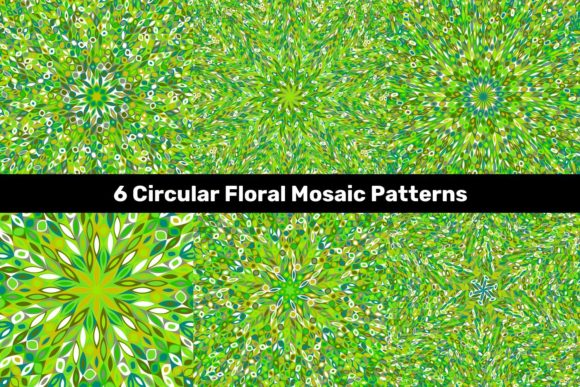
6 Green Circular Floral Mosaic Patterns
If you're designing branding materials, packaging, digital backgrounds, or print collateral—and especially if you value organic elegance with modern versatility—you’ll recognize the quiet power of 6 Green Circular Floral Mosaic Patterns. This package isn’t just a collection of pretty graphics. It’s a carefully crafted set of six high-resolution, scalable, and thoughtfully composed circular floral motifs—each built around harmonious green palettes, balanced symmetry, and botanical detail that feels fresh, not fussy.
What makes this set stand out isn’t just aesthetics—it’s practicality. Each design arrives in three essential formats: JPG files (5000×5000 pixels), vector EPS files, and Adobe Illustrator (.AI) files. That means whether you’re preparing social media banners, laser-cut signage, embroidered textile mockups, or large-format wall graphics, you’re covered for resolution, editing flexibility, and production readiness.
Common Missteps—and Why They Slow You Down
Many people assume “floral” means “decorative only”—and treat these patterns as background fillers rather than strategic visual assets. That mindset leads to underuse, mismatched applications, or last-minute format scrambles. Here’s what often goes wrong—and how to sidestep it.
Mistake 1: Assuming JPGs Are Enough for All Uses
It’s tempting to grab the high-res JPGs and call it done—especially if you’re building a quick Canva presentation or Instagram story. But JPGs are raster-only: they don’t scale infinitely, can’t be recolored without reworking layers, and won’t hold crisp edges when enlarged for signage or apparel prints. One designer printed a JPG-based pattern on a 48″ trade show banner—only to discover visible pixelation at arm’s length. The fix? Vector files. Always verify your end use before committing to a format.
Mistake 2: Overlooking Color Consistency Across Formats
Not all vector files preserve color profiles identically. Some EPS exports default to CMYK while others retain RGB—leading to unexpected shifts when moving from screen to print. A small-batch candle label designer noticed her rich forest-green motif turned slightly dull on press because the .EPS was embedded in an outdated color space. Her solution? Open each .AI file first, confirm the document color mode matches her output (RGB for web/digital, CMYK for offset printing), then export new EPS versions with embedded profiles.
Mistake 3: Ignoring Pattern Repeat Logic
These aren’t seamless tile repeats—they’re self-contained circular compositions. That’s intentional. But some users try to force them into repeating wallpaper layouts or fabric swatches without adjusting spacing or alignment, resulting in awkward gaps or overlapping petals. Instead of stretching or duplicating, consider using each circle as a focal element: center one on a business card, place two diagonally on a notebook cover, or layer one subtly behind typographic headers. Their strength lies in intentionality—not infinite tiling.
What to Check Before You Download—or Buy
Before adding 6 Green Circular Floral Mosaic Patterns to your workflow, ask yourself three things:
- What’s my primary output medium? If it’s web or social, JPGs are perfectly sufficient—but keep the .AI files archived for future edits or brand expansions.
- Do I need editable components? The .AI files include layered paths and grouped elements—ideal if you want to isolate leaves, adjust petal opacity, or swap stems for custom illustrations. Open one in Illustrator to test layer organization before committing to a project.
- Is my software compatible? While EPS is widely supported, newer versions of Affinity Designer or CorelDRAW may require minor import tweaks. Test one .EPS file in your usual app first—most platforms handle Illustrator-native .AI files more reliably.
Better Choices Start With Clarity
One freelance educator used these patterns to redesign her online course landing pages—not as full backgrounds, but as subtle corner accents beside section headers. She exported each .AI file as individual SVG icons, applied CSS transitions for hover effects, and kept load times low. Result? Higher engagement, zero licensing concerns, and visual continuity across devices.
Another small-batch ceramicist licensed the same set—not for digital use, but as stencil guides. She imported the .AI files into her CNC software, scaled them precisely to fit mug diameters, and cut clean, repeatable motifs into clay slabs. Because the vectors retained sharp curves at any size, her stencils held fine detail even at 2.5 inches across.
These aren’t edge cases. They reflect how thoughtful format awareness multiplies utility. You don’t need advanced skills to benefit—just the habit of matching file type to purpose.
A Note on Green—Beyond Aesthetic
The green palette here isn’t arbitrary. It spans sage, moss, emerald, and olive tones—colors associated with growth, balance, and grounded creativity. That makes them especially effective for wellness brands, eco-conscious startups, educational resources, or artisanal packaging where authenticity matters. But avoid assuming “green = natural = neutral.” These hues carry weight and warmth. Test them against your existing brand colors—especially black text or warm-toned photography—to ensure contrast and readability.
One blogger learned this the hard way when she overlaid white body copy on a dense leafy circle—only to find low legibility on mobile. Her revision? Using the same pattern at 15% opacity as a watermark behind clean sans-serif headings, letting meaning and message stay front and center.
Final Thought: Use What Serves—Not Just What’s Included
You don’t need all six patterns at once. Start with one that aligns with your current project’s mood and scale. Study its composition: notice how negative space balances floral density, how curvature guides the eye, how repetition within the circle creates rhythm without rigidity. Then decide whether to use it whole, crop a segment, or extract a single stem as a standalone icon.
That kind of deliberate selection—backed by format awareness and real-world testing—is what transforms a design asset from decorative to functional. 6 Green Circular Floral Mosaic Patterns gives you the tools. Your context, goals, and attention to detail determine how far they go.