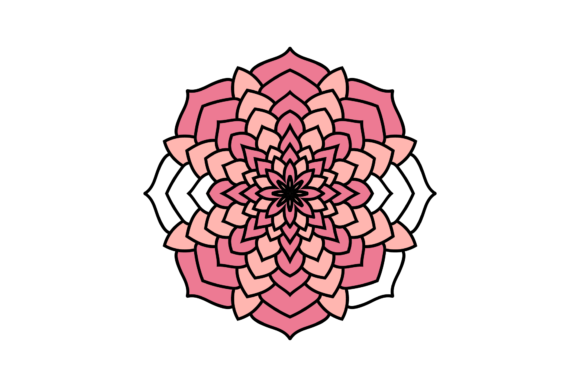
Mandala Patterns Decorative Color: Design Flexibility Meets Intentional Aesthetics
Today’s creative professionals and small business owners don’t just need beautiful visuals — they need adaptable, production-ready assets that align with both brand authenticity and technical realities. Mandala Patterns Decorative Color fits precisely into that space: a thoughtfully composed digital design resource that balances symbolic resonance with practical utility. Unlike generic clipart or overly stylized stock graphics, these patterns carry visual harmony and cultural nuance while remaining fully editable, scalable, and format-agnostic.
Why Mandala Patterns Resonate Beyond Trend
Mandalas have long served as tools for focus, balance, and reflection across spiritual and artistic traditions. In contemporary design, their appeal has shifted — not toward ritual use alone, but toward visual language that conveys intention, symmetry, and calm amid digital clutter. That shift matters: consumers increasingly associate clean, centered compositions with trustworthiness and mindfulness. Brands in wellness, education, coaching, and even fintech are integrating mandala-inspired motifs to soften messaging without sacrificing professionalism.
What makes Mandala Patterns Decorative Color especially relevant now is its intentional color treatment. It avoids oversaturated gradients or fleeting palettes, instead offering harmonious, accessible color schemes that work across screens, print, and physical products. These aren’t “decorative” in the sense of being ornamental filler — they’re decorative *with purpose*: supporting readability, guiding attention, and reinforcing tone.
Designed for Real Workflows — Not Just Inspiration
Creative workflows today rarely begin and end in one application. A designer might sketch in Procreate, refine in Adobe Illustrator, prep files for a Cricut machine, export assets for a Shopify banner, and then adapt the same motif for an Instagram carousel. Mandala Patterns Decorative Color supports that fluidity — not as a theoretical ideal, but as a built-in feature.
The six included file formats serve distinct, real-world functions:
- AI and EPS files preserve vector integrity for unlimited scaling — essential when adapting a pattern for large-format wall decals or tiny app icons.
- SVG enables seamless integration into web projects, supporting responsive behavior and CSS-based color adjustments without re-exporting.
- DXF bridges digital design and physical fabrication — critical for laser cutters, vinyl plotters, and CNC machines used by makers, educators, and boutique product creators.
- JPG and PNG offer immediate usability: quick mockups, social media posts, presentation decks, or client previews — no software required beyond standard image viewers.
This isn’t about checking format boxes. It’s about eliminating friction between idea and execution. A yoga studio owner can drop the SVG into Canva to customize a workshop flyer. A textile designer can import the AI file into Affinity Designer to recolor and repeat the motif across fabric swatches. A teacher preparing classroom materials can paste the PNG into Google Slides and layer it behind student-facing instructions — all within minutes.
Color That Works — Not Just Looks Good
“Decorative color” often implies ornamentation over function. Mandala Patterns Decorative Color challenges that assumption. Each palette is built with contrast, accessibility, and context in mind. The 1920px × 1280px canvas size strikes a pragmatic balance: large enough for high-resolution output (including retina displays and printed posters), yet manageable for everyday editing on mid-tier hardware.
That resolution also reflects how people actually use digital assets today. It’s not oversized for billboard printing — nor undersized for web banners. It’s sized for versatility: fitting cleanly into common presentation slide ratios, matching standard desktop wallpaper dimensions, and scaling predictably for mobile overlays. No cropping, no guesswork, no last-minute resampling that degrades detail.
How This Fits Modern Creative Expectations
Expectations have changed. Five years ago, many buyers accepted static JPGs and hoped for the best. Today, users expect interoperability — the ability to modify, repurpose, and extend assets without licensing hurdles or technical dead ends. They expect clarity around what they’re getting, not vague promises like “high-res files” or “commercial use.”
Mandala Patterns Decorative Color meets those expectations transparently. There’s no upsell loop, no hidden limitations, no requirement to purchase additional licenses for different uses. The AI, EPS, SVG, DXF, JPG, and PNG files are delivered together — no tiered packages, no format exclusions. That transparency builds trust, especially among freelancers and small teams who budget carefully and need certainty before committing time or money.
It also respects users’ time. “Easy to edit and use in your designs” isn’t marketing fluff here — it’s a functional outcome of deliberate format selection and clean vector construction. Paths are simplified where appropriate, layers are logically named (in editable files), and transparency is preserved in PNGs without unnecessary background artifacts. There’s no reverse-engineering required — just open, adjust, and deploy.
Practical Use Cases Across Roles
The strength of Mandala Patterns Decorative Color lies in its quiet adaptability — not in niche specialization. Consider how different professionals might apply it:
- Educators use the SVG version to create interactive geometry lessons, overlaying mandala symmetry concepts onto digital whiteboards or printable worksheets.
- Content creators embed the PNG into YouTube thumbnails or podcast cover art — adding visual cohesion without competing with text or faces.
- Small business owners import the DXF into Cricut Design Space to cut mandala stencils for hand-painted signage or custom packaging inserts.
- Bloggers and newsletter writers insert the JPG into Mailchimp templates as subtle dividers or section backgrounds — reinforcing brand calm without distracting from copy.
- Product designers extract individual elements from the AI file to build cohesive icon sets or UI patterns for meditation or journaling apps.
None of these require advanced skills — just basic familiarity with common tools. That lowers the barrier to professional-grade design, especially for solopreneurs managing multiple roles.
Looking Ahead — Without Overpromising
Design resources won’t replace thoughtful strategy — and Mandala Patterns Decorative Color doesn’t claim to. What it does offer is reliable, respectful infrastructure: assets that behave consistently, scale without compromise, and integrate smoothly into evolving toolchains. As generative AI reshapes how we source and modify visuals, having well-structured, human-crafted foundations becomes more valuable — not less. These files aren’t meant to be prompts; they’re meant to be starting points you control.
They also reflect a broader shift toward intentionality in visual communication. People aren’t seeking louder, busier, or more complex — they’re gravitating toward clarity, coherence, and quiet confidence. A mandala pattern doesn’t shout. It invites pause. And in a world saturated with rapid-scroll content, that invitation carries weight.
If you’re evaluating whether this set fits your needs, ask two simple questions: Do I need a versatile, ready-to-use pattern that works across platforms and purposes? And do I value clean execution over novelty for novelty’s sake? If the answer is yes to both, Mandala Patterns Decorative Color delivers exactly that — no reinterpretation required.